
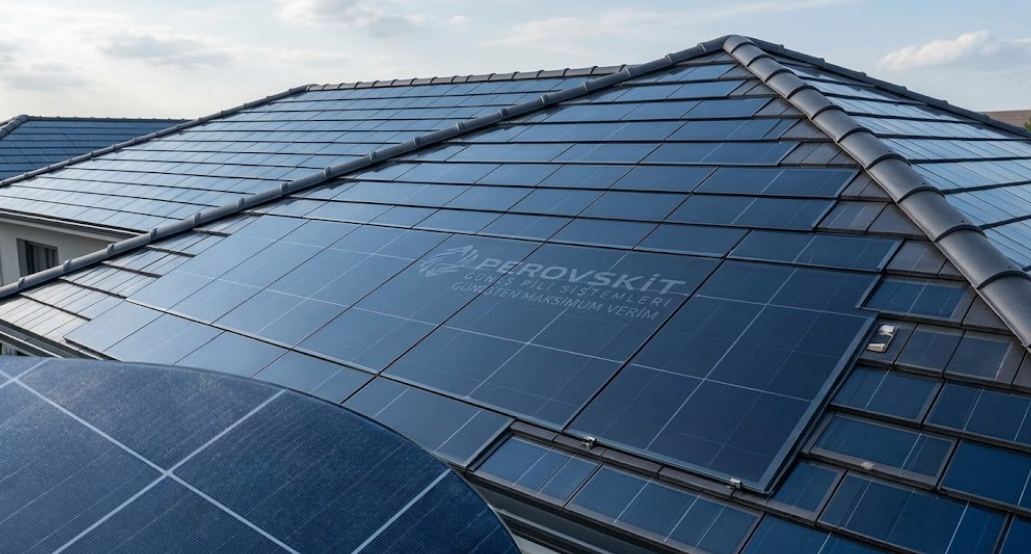
Perovskite Solar Panels: The New Technology That Could Transform Solar Energy in 2026
Solar technology is entering a new phase. For decades, crystalline silicon has dominated the photovoltaic industry, but a new material is attracting enormous attention from researchers, manufacturers and investors: perovskite.
Perovskite solar panels could become one of the most important developments in renewable energy technology because they offer the possibility of achieving very high efficiency while using potentially thinner and more flexible solar materials.
According to the International Energy Agency, solar perovskite has become one of the fastest-growing areas of solar research and patent activity. In 2025, perovskite reached several important innovation milestones, including a solar cell at marketable dimensions with an efficiency of 33%.
What Are Perovskite Solar Panels?
Perovskite solar panels use a photovoltaic material with a specific crystal structure known as a perovskite structure.
Unlike traditional silicon solar cells, which require relatively thick semiconductor wafers, perovskite materials can potentially be manufactured as extremely thin layers.
This creates several possibilities for the solar industry.
Perovskite solar technology could potentially enable:
- Higher solar-cell efficiency
- Lightweight solar modules
- Flexible solar surfaces
- Semi-transparent photovoltaic products
- Lower material consumption
- Tandem solar cells combining different materials
The technology is particularly interesting because perovskite materials can absorb parts of the solar spectrum that conventional silicon cells cannot use as efficiently.
Why Is Perovskite Solar Technology Important?
The efficiency of a solar cell determines how much electricity it can produce from a given amount of sunlight.
Traditional silicon technology has improved dramatically, but researchers are approaching the practical limits of single-junction silicon photovoltaics.
Perovskite offers another route.
Instead of replacing silicon completely, researchers are increasingly investigating ways to place perovskite on top of silicon.
This creates what is known as a tandem solar cell.
The concept is relatively simple: different materials capture different portions of the sunlight spectrum.
The result can be a higher overall conversion efficiency.
The U.S. Department of Energy notes that perovskite materials can be tuned to capture portions of the solar spectrum that silicon does not use efficiently, making them particularly attractive as partners for tandem solar cells.
Perovskite vs. Traditional Silicon Solar Panels
Traditional silicon panels have a major advantage: decades of manufacturing experience.
Silicon photovoltaic technology is already produced at enormous scale, with established supply chains, manufacturing facilities and long-term performance data.
Perovskite is different.
The technology is still moving from laboratory demonstrations toward large-scale commercial production.
That means several questions remain important.
How long will perovskite modules last?
Can they withstand heat, humidity and ultraviolet radiation?
Can manufacturers produce large modules consistently?
Can the technology compete economically with mass-produced silicon?
These are some of the central challenges researchers are currently trying to solve.
The Durability Challenge
One of the biggest obstacles facing perovskite solar panels is stability.
A laboratory solar cell can achieve impressive efficiency, but commercial solar panels must operate outdoors for many years.
They have to deal with:
- High temperatures
- Humidity
- Ultraviolet radiation
- Temperature cycling
- Mechanical stress
- Long-term exposure to sunlight
Researchers are therefore focusing not only on efficiency but also on durability.
In 2026, the U.S. Department of Energy announced research aimed at improving the ultraviolet and high-temperature durability
