
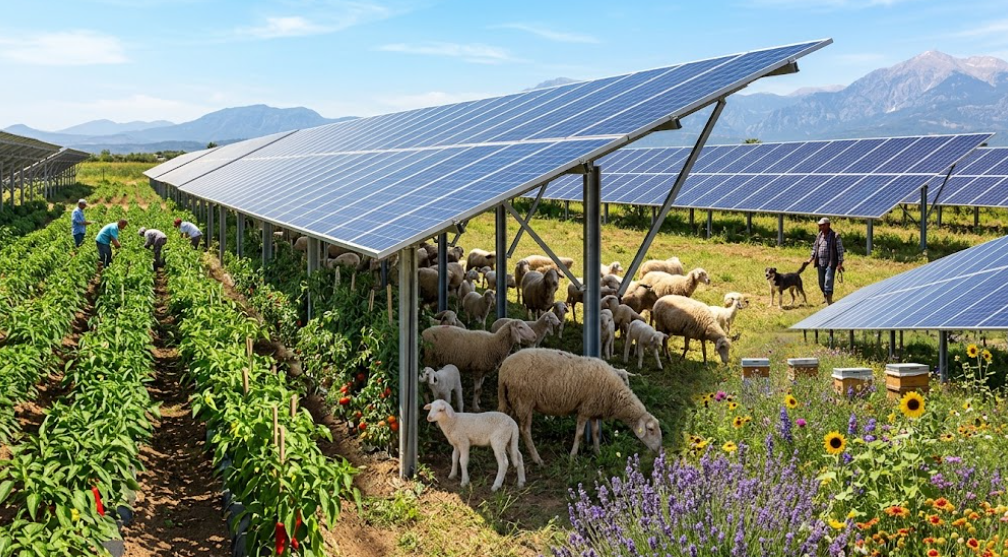
Agrivoltaics: How Solar Panels and Farming Can Share the Same Land
What if the same piece of land could produce both food and electricity?
That is the idea behind agrivoltaics, one of the most interesting emerging applications of solar energy.
Instead of using land exclusively for solar panels, agrivoltaic systems combine photovoltaic electricity generation with agricultural production.
Crops, livestock or pollinator habitats can exist underneath or between rows of solar panels.
The U.S. Department of Energy describes agrivoltaics as a form of dual-use photovoltaic technology in which agriculture and solar generation occupy the same land.
What Is Agrivoltaics?
Agrivoltaics combines:
Agriculture + Photovoltaic Solar Energy
Solar panels are installed above crops or between agricultural areas.
Depending on the design, the panels can create partial shade while generating electricity.
This creates an unusual relationship between agriculture and renewable energy.
The objective is not simply to build a solar farm on farmland.
The objective is to design the system so that both agricultural production and electricity generation can coexist.
Why Is Agrivoltaics Becoming Important?
Land is one of the biggest considerations in large-scale solar development.
Solar farms require significant areas of land.
At the same time, agricultural land is needed for food production.
Agrivoltaics offers a potential way to reduce competition between these two uses.
Instead of asking:
“Should this land be used for agriculture or solar energy?”
Agrivoltaics asks:
“Can this land provide both?”
Can Crops Grow Under Solar Panels?
Yes, although the results depend heavily on crop type, climate, panel design and agricultural practices.
Solar panels can change the amount of sunlight reaching the ground.
They can also affect temperature, wind and moisture conditions.
For certain crops and environments, partial shade may be beneficial.
For others, reduced sunlight could negatively affect production.
This means agrivoltaics is not a universal solution.
Each project needs to be designed around local conditions.
Can Solar Panels Reduce Water Use?
One potential benefit is reduced evaporation.
Solar panels can create shade over portions of the agricultural area, potentially changing soil and plant water conditions.
The DOE notes that agrivoltaic systems can potentially reduce irrigation requirements in some situations.
However, the actual result depends on climate, crop type, irrigation system and panel configuration.
Agrivoltaics and Livestock
Agrivoltaics does not have to involve crops.
Livestock can also be integrated into solar projects.
Animals can graze between or underneath solar panels while the panels generate electricity.
This creates another form of dual land use.
For some projects, grazing can also reduce vegetation management requirements.
Solar Panels Can Provide Shade
One of the most interesting aspects of agrivoltaics is that solar panels are not simply energy-producing devices.
They can also become part of the agricultural environment.
Depending on the design, panels can provide shade during periods of intense sunlight.
This may be especially relevant in hot and dry climates.
The challenge is finding the right balance.
Too much shade can reduce crop growth.
Too little shade may provide limited environmental benefits.
What Crops Work Best?
There is no single list of universally suitable crops.
Researchers investigate different crops based on:
- Sunlight requirements
- Climate
- Temperature
- Water requirements
- Crop height
- Harvesting methods
- Panel spacing
Vegetables, fruits, forage crops and other agricultural systems can potentially be evaluated.
The best configuration depends on the specific location.
Agrivoltaics in 2026
Agrivoltaics is moving beyond small experimental installations.
In August 2026, the U.S. Department of Energy announced proposed funding for research into agrivoltaic treatments at industrial-scale solar facilities, including studies involving food production, native grasses and climate-smart crops.
This illustrates how researchers are increasingly studying agrivoltaics at larger scales.
The Challenges of Agrivoltaics
The technology also has important challenges.
Installing elevated solar structures can increase construction costs.
Agricultural machinery must be able to operate around the solar infrastructure.
Panels need to be positioned correctly.
Farmers need to maintain access to crops and equipment.
There can also be questions regarding crop yields, project economics and long-term maintenance.
Therefore, agrivoltaics should not be viewed as simply “putting solar panels over a farm.”
It is an integrated engineering and agricultural system.
Could Agrivoltaics Change Solar Farming?
Potentially.
As solar deployment continues to expand, land-use questions are becoming increasingly important.
Agrivoltaics offers one possible strategy for producing renewable electricity while maintaining agricultural activity.
It could be particularly attractive in regions where land is expensive or agricultural production is economically important.
The technology could also become increasingly relevant as climate conditions change.
The Future of Agrivoltaics
The future of solar energy may involve more than traditional solar farms and rooftop panels.
Solar could increasingly become integrated into agricultural landscapes.
Farmers could potentially produce food and electricity from the same land.
Solar developers could gain access to dual-use projects.
Communities could benefit from renewable electricity without necessarily removing agricultural activity from the site.
Agrivoltaics therefore represents a fundamental change in the way solar infrastructure can interact with land.
Instead of viewing agriculture and renewable energy as competing uses, agrivoltaics attempts to make them complementary.
SEO Keywords: agrivoltaics, agrivoltaic solar panels, solar panels and farming, solar farming, agrivoltaics 2026, dual use solar, agricultural solar panels
Meta Description: Agrivoltaics combines solar panels and agriculture on the same land. Learn how solar farming works, its benefits, challenges and future potential.
