
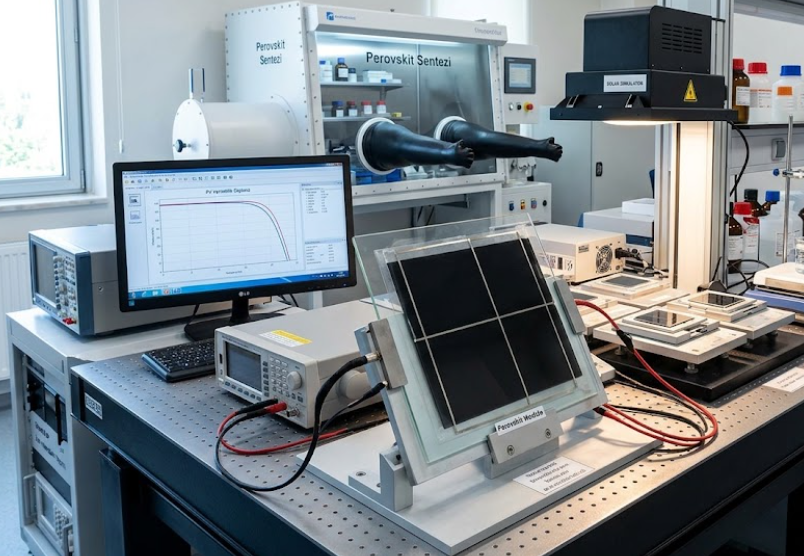
Perovskite Tandem Solar Panels: How the Next Generation of Solar Cells Could Beat Traditional Silicon
The solar industry has spent decades improving silicon photovoltaic technology. Now, researchers are developing a new approach that could significantly increase the amount of electricity produced from sunlight: perovskite-silicon tandem solar cells.
Rather than trying to replace silicon, tandem technology combines two photovoltaic materials in a single solar cell.
The idea is straightforward: one material captures one part of the solar spectrum, while another captures a different part.
This can potentially produce more electricity from the same amount of sunlight.
What Is a Tandem Solar Cell?
A tandem solar cell contains multiple photovoltaic layers with different properties.
Traditional silicon solar cells use one primary photovoltaic junction.
A tandem cell adds another photovoltaic material on top.
One of the most promising combinations is:
Perovskite + silicon
Perovskite can be engineered to absorb high-energy portions of sunlight while silicon absorbs other wavelengths.
This division of the solar spectrum can reduce some of the efficiency losses associated with single-junction solar cells.
The U.S. Department of Energy says tandem devices can potentially exceed 33% power-conversion efficiency, above the theoretical limit of a conventional single-junction PV cell under standard conditions.
Why Is Perovskite Combined With Silicon?
Silicon has one enormous advantage: it is mature.
The global photovoltaic industry already has factories, equipment and supply chains designed around silicon.
Perovskite, meanwhile, has attractive optical and electrical properties but still faces commercialization challenges.
Combining the two could provide a bridge between today’s solar industry and next-generation photovoltaic technology.
Instead of throwing away the existing silicon ecosystem, manufacturers could add a perovskite layer to improve performance.
Could Tandem Panels Produce More Electricity?
Potentially, yes.
The key advantage is not simply higher laboratory efficiency.
Higher efficiency means more electrical power can potentially be generated from the same physical area.
Imagine two rooftops of identical size.
If one uses a lower-efficiency module and the other uses a higher-efficiency module, the higher-efficiency system can potentially produce more electricity without requiring additional roof space.
This is particularly valuable in:
- Cities
- Commercial buildings
- Industrial rooftops
- Space-constrained solar farms
- Building-integrated photovoltaics
The Efficiency Race
Efficiency has become one of the major areas of competition in advanced solar technology.
The IEA reported that 2025 brought important perovskite innovation milestones, including a 33% efficiency solar cell at marketable dimensions.
However, laboratory records and commercial solar panels are not the same thing.
A commercially useful solar module must be:
- Reliable
- Affordable
- Scalable
- Durable
- Easy to manufacture
- Capable of maintaining performance outdoors
This is why tandem commercialization is more complicated than simply achieving a new efficiency record.
The Biggest Problem: Stability
Perovskite materials can be sensitive to environmental conditions.
Heat, moisture and ultraviolet radiation can accelerate degradation if the cell is not properly engineered and protected.
That is why current research increasingly focuses on long-term durability.
In June 2026, the U.S. Department of Energy described research focused on improving the outdoor durability of tandem perovskite-silicon devices under ultraviolet exposure and high temperatures.
This is an important part of the transition from laboratory research to commercial products.
Manufacturing Is Another Challenge
Producing a tiny laboratory cell is very different from producing millions of large solar modules.
Large-area manufacturing introduces problems involving:
- Uniform coating
- Defects
- Interconnection
- Encapsulation
- Production speed
- Quality control
- Long-term reliability
The DOE’s current tandem research programs specifically address scaling, process reproducibility, stability and module performance under realistic operating conditions.
Will Tandem Solar Panels Be More Expensive?
Initially, advanced technology is generally more expensive to manufacture.
However, the relevant question is not only the price of the panel.
Developers also consider how much electricity a panel generates over its lifetime.
A more efficient panel can potentially generate more electricity from the same area.
If manufacturing costs fall while efficiency remains high, tandem panels could become increasingly competitive.
What Could Tandem Solar Mean for Consumers?
For homeowners, one of the biggest potential advantages is higher output from limited roof space.
A homeowner with a small roof may not have enough area for a conventional system to meet all electricity needs.
Higher-efficiency modules could potentially increase electricity generation without expanding the installation footprint.
The same principle applies to commercial buildings and solar farms.
The Future of Tandem Solar
The future of solar energy may not involve one technology completely replacing another.
Instead, the industry could evolve toward combinations of technologies.
Silicon provides a mature foundation.
Perovskite provides another photovoltaic layer capable of capturing sunlight differently.
Together, they create a tandem architecture with the potential for substantially higher efficiency.
The challenge now is commercialization.
If researchers can solve stability, manufacturing and cost issues, perovskite-silicon tandem technology could become one of the most important developments in photovoltaic technology during the second half of the 2020s.
The solar panel of the future may therefore look surprisingly familiar.
It could still contain silicon.
But underneath the glass, an additional perovskite layer could fundamentally change how efficiently sunlight is converted into electricity.
SEO Keywords: perovskite tandem solar panels, tandem solar cells, perovskite silicon tandem, tandem solar technology, high efficiency solar panels, next generation solar panels
Meta Description: Perovskite tandem solar panels could push solar efficiency beyond traditional silicon technology. Learn how tandem cells work, their benefits and remaining challenges.
